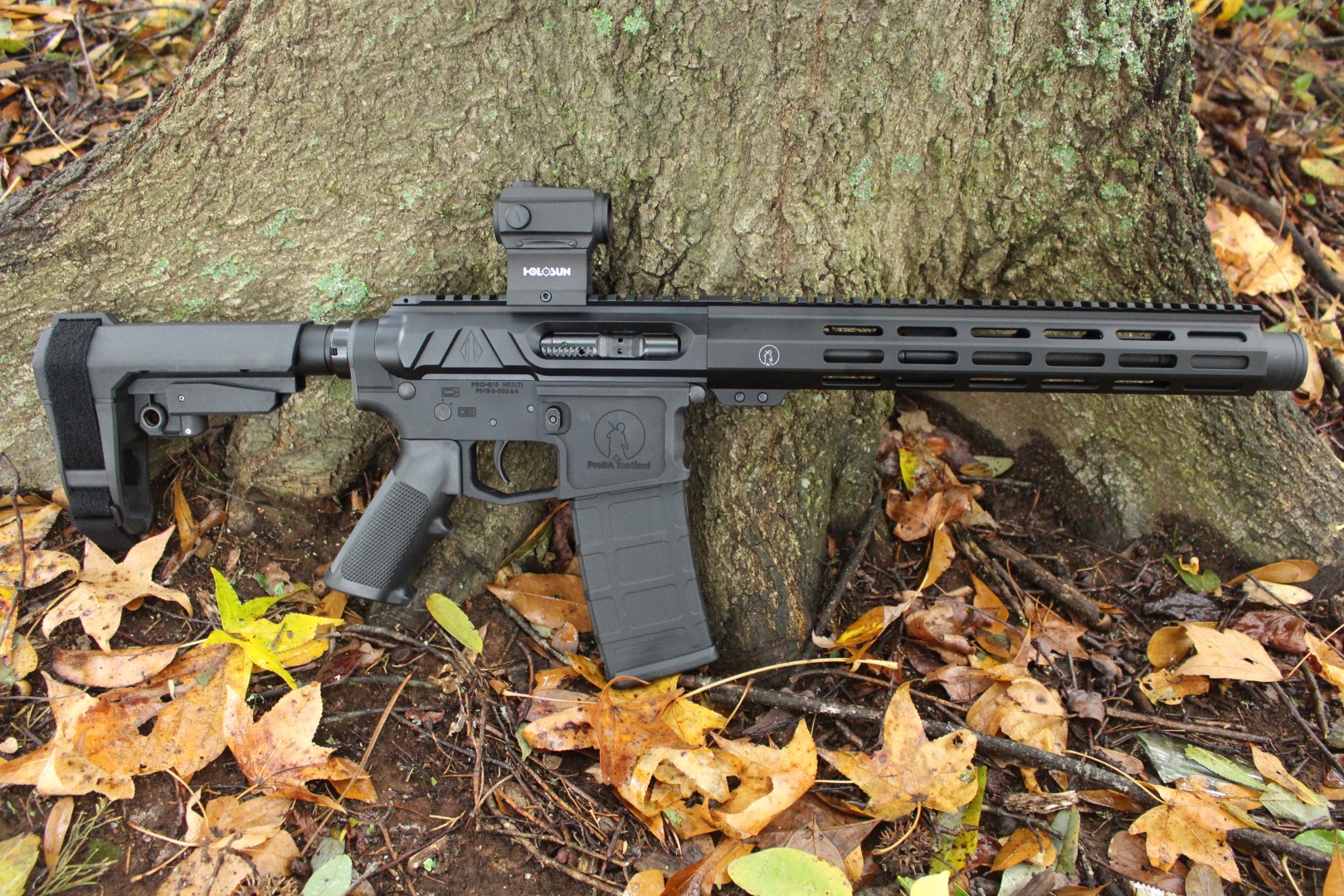
The debate over what constitutes a great home defense gun is never-ending. From pistols and shotguns to AR-15s and PDW-style firearms, there are many options. For me, it's a personal choice—and much of it depends entirely on your environment. This isn’t just a gun to defend your home’s interior, but also as a tool to protect your property. That could mean a sprawling farm, a single-family house in a neighborhood, or a one-bedroom apartment in a populated urban center. Each situation calls for something different. It also comes down to what you’re comfortable with. What do you train with most? Is it an AR-15, a handgun, or a shotgun? Likewise, is your weapon setup suited for your environment? Accessories such as optics, weapon-mounted lights, and slings all serve a purpose. Even the ammunition and magazines you use need to be validated.
As someone living in a single-family home in a modern development surrounded by fields, I am in a unique situation. The house is situated on a 1/3-acre corner lot near the main entrance. Egress is straightforward, with two side entrances also accessible. There are unobstructed views down two streets — one exceeding 1,000 yards and the other about 400 yards. Behind the furthest house, a farm borders the neighborhood on two sides.
To me, 300 Blackout was an obvious choice. After consulting a ballistic chart, it made my decision became even more definitive. The 300 Blackout offers a wide range of subsonic and supersonic loads, making it ideal for the environment in which I live. However, first, a brief overview of the 300 Blackout is necessary.
The 300 AAC Blackout, often referred to as the 300 Blackout, has an interesting history. Its origins go back to the 1960s, starting with the necking of the .221 Remington Fireball to .30 caliber. The .221 was created to deliver better performance in Remington’s XP-100 bolt-action pistols. Later, the .30/.221 cartridge caught the eye of well-known wildcatter and custom gun manufacturer J.D. Jones of SSK Industries. He trademarked it as the 300 Whisper and developed it to shoot heavy-for-caliber bullets, such as 200 grains, at subsonic speeds, thereby avoiding the crack that occurs when rounds cross the sound barrier.
This cartridge gained popularity, especially in the AR-15 platform. However, since it was trademarked, manufacturers couldn’t officially label a gun as a 300 Whisper unless a licensing agreement was signed. But the cartridge wasn’t SAAMI (Sporting Arms and Ammunition Manufacturers’ Institute) approved. That opened the door for a wider adoption under a different name.
The following quote is taken from a 2024 Firearms News article by David Fortier on the History of the 300 AAC Blackout Cartridge, who is friends with Robert Silvers, the man behind the 300 AAC Blackout. In 2010, Silvers was the R&D Director of Advanced Armament Corp. (AAC). He had this to say about the creation of 300 Blackout,
“With Remington already doing the .221 and .17 Fireball, it was a natural to do the .30 caliber. But Remington is a SAAMI company and only makes SAAMI-approved ammunition. So, we had to create the final specifications of the cartridge and seek SAAMI acceptance. The problem with calling it the .300 Fireball was two-fold. One is that the cartridge is low visibility, and Fireball seems like the opposite of that. The other is that there were too many chamber drawings for wildcat versions called .300 Fireball. If we picked that name, we would have to clear compatibility with these existing chambers, and that would limit velocity potential because we would have to pressure-test the ammo in the tightest one. 300 Whisper® is a proprietary name which requires licensing, and SAAMI does not accept trademarked names. Also, I did not want to use it because it implies subsonic is the primary use — and that is not the way I see the cartridge. 300 AAC Blackout was designed to be the most powerful way to shoot .30 caliber from an AR-15 while remaining compatible with normal 30-round magazines…”
There's a lot to unpack, but this laid the groundwork for the standardization of the 300 Blackout and its eventual rise in popularity. Interestingly, I find it notable that Silvers didn’t see subsonic as the cartridge’s main purpose, which is the opposite today. The main reason for choosing this cartridge is for subsonic use. Generally, it can be inferred that the rise in suppressor ownership, along with the spread of short-barreled ARs as pistols with stabilizing braces, has made Silvers’s original intent irrelevant.
December 13, 2025
|
View: 376
|
By: Admin









Comments